
Espresso practice · 3 MIN READ

Dose & yield

Dose is dry coffee in the basket; drink weight is the weighed espresso in the cup. Together they define your brew ratio.

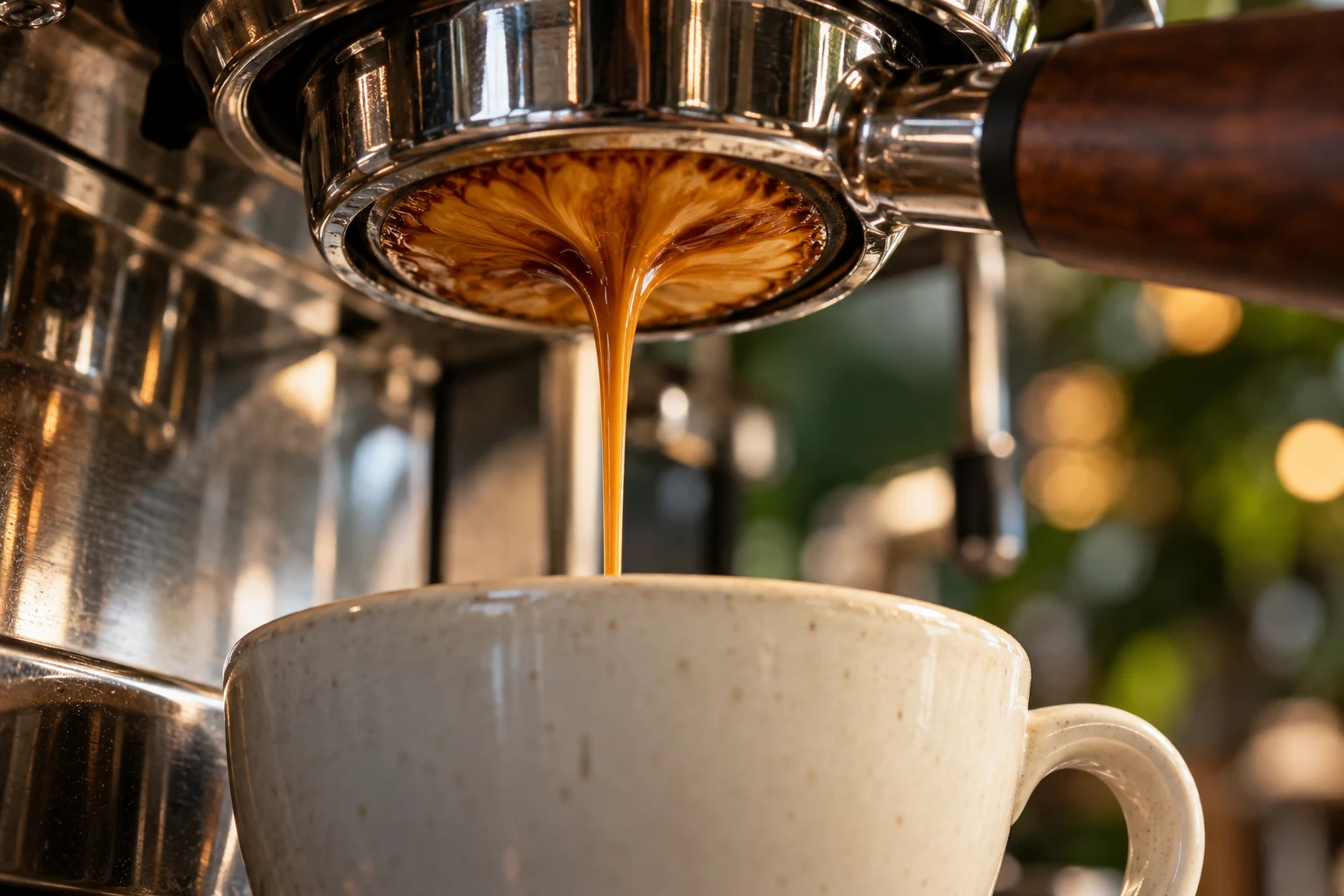
Espresso flowing from a portafilter into a cup

Knowledge you can explore

In, out, clearly recorded

Three views make the relationship visible. Choose a question, compare the diagram and check your understanding.

The basket sets the limitsYour dose is the dry coffee in the basket. It must suit the basket size and leave the intended space beneath the shower screen. Hard tamping creates no extra capacity. For a substantially different portion, a suitable basket makes more sense than extreme overfilling or underfilling.01 / 03
  1. Suitable doseSuitable dose
  2. Space below the showerSpace below the shower
  3. Basket size limits the portionBasket size limits the portion

Scroll the diagram sideways to read every label.

Dose must fit the basket

Schematic illustration · not a measurement or real-time demonstration

01 / 03

The basket sets the limits

Your dose is the dry coffee in the basket. It must suit the basket size and leave the intended space beneath the shower screen. Hard tamping creates no extra capacity. For a substantially different portion, a suitable basket makes more sense than extreme overfilling or underfilling.

02 / 03

Beverage mass before foam level

Weigh the finished espresso including its crema. Foam changes the visible volume, making it a less clear recipe measure. Write beverage mass in grams because yield can also mean the proportion of material extracted. Record the actual final mass and allow for drips after the machine stops.

03 / 03

Longer extraction does more than dilute

Keep dose, grind and preparation fixed while comparing two beverage masses. In a longer extraction, additional water passes through the puck and continues dissolving material. Adding water afterwards is therefore a different option. Judge body and balance separately rather than assuming that more liquid is automatically better.

A quick thought check

Why record beverage mass in grams rather than the fill level?

Explore the numbers and controls

01 / Make quantities visible

Schematic illustration · the calculation is exact

Coffee + water

Your quantity.
Your ratio.

Filter coffee calculates water going in. Espresso usually calculates drink coming out. Change the method and see what the number means.

320 gPour in brewing water

The quantity in the cup is smaller: coffee and filter retain water. Your equipment’s capacity limits the portion.

Understand brew ratios ↗
01

Choose a suitable dose first

The dose is the weight of dry grounds in the espresso basket. Choose it to match the intended basket capacity. Tamping harder does not make a small basket arbitrarily larger; heavily underfilling a large basket is not automatically a good solution for a small serving either. A suitable basket is often a better starting point for a different serving size.

Use the intended basket dose and the bean as your guide. If too little space remains below the shower screen, the coffee bed may touch it before brewing. For a different portion size, use a suitable basket where possible rather than extreme overfilling or underfilling.

02

Name the drink yield clearly

In everyday use, yield often means the weight of finished espresso. In technical texts, extraction yield can instead mean the proportion of substances dissolved from the dry coffee. To avoid confusion, simply write beverage quantity in grams in your recipe.

18 grams of coffee and 36 grams of drink give 1:2. With 45 grams of drink, it is 1:2.5. This calculation is independent of how much crema floats on top. Scales are therefore more useful than reading a volume.

03

How to compare two quantities

  1. Keep dose, grind size and preparation the same.
  2. Brew a first espresso to your usual drink yield.
  3. Stop a second shot slightly earlier or later without deliberately changing other variables.
  4. Stir both and taste at a similar temperature. Record body and balance separately.
04

What a longer extraction changes

A longer extraction sends more water through the puck. This changes both concentration and what continues to dissolve. A longer espresso is therefore not simply the same espresso with more water. A short extraction diluted afterwards is a distinct variation.

If a short shot is intense but sharp, a little more beverage can be worth trying. If a long extraction seems thin and unpleasantly bitter, an earlier stop may suit it. There is no guaranteed automatic flavour outcome, however. The bean and evenness remain important.

05

Allow for drips after stopping

Some machines release a little more liquid after the stop signal. Observe your combination of machine, cup and scales. You can learn to stop slightly before the target without making every decimal place compulsory. What matters is the actual final weight.

06

Do not change two controls at once

If you increase the dose and stop earlier at the same time, the cup may become stronger. But you will barely know which part of the change improved the flavour. When troubleshooting, keep the dose constant at first. Plan a new ratio only when you deliberately want to change the portion size.

07

A clear recipe sheet

For example, write: “18 grams in, 40 grams out; timing from pump start; same pre-infusion.” This is more precise than “double espresso, normal length”. Record the grinder setting too. After an adjustment, you can then trace which recipe you actually brewed.

Frequently asked

Another question?

Do I need to remove the crema?

No. Weigh the whole drink; crema only makes volume measurements harder.

Is yield the same as extraction?

The term is used in different ways. Explicitly distinguish beverage yield from extraction level.

Sources & further reading

Related to this topic

Choose drink weight deliberately

Calculate your starting ratio and compare a slightly different drink weight at the same dose. Record body and balance separately.

Espressoverhältnis berechnen ↗

Your coffee helper

Coffee Bro.

I help you brew, find coffee knowledge and show you what is on the menu. Your questions stay here in your browser.

Local content & guided help · no connected language model