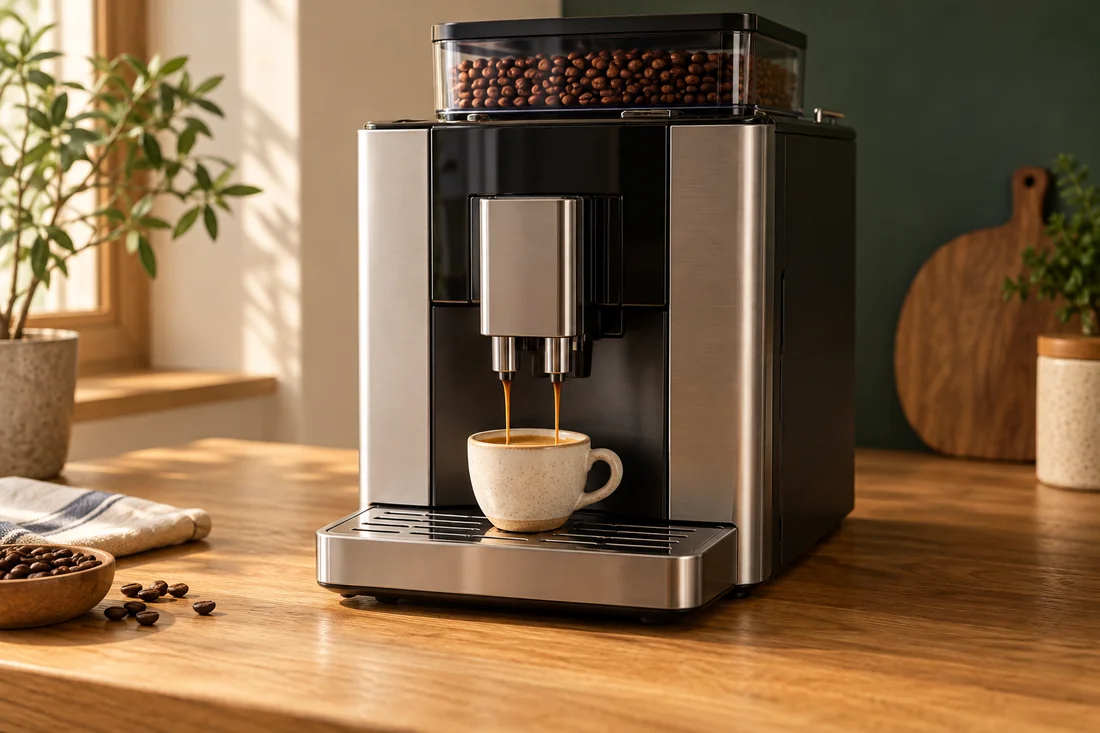
The guide · Automatic

Bean-to-cup machine

Choose a drink, then adjust strength, quantity and grind one after another.

Recipe, techniques and troubleshooting. All on one page.

Automatic — illustrative image

Your starting recipe

Your cup starts here.

A starting point for your beans and your taste.

Start
a black drink
Strength
medium setting
Quantity
small suitable portion
Grind setting
change only as instructed

What you need

Have these ready.

Tick off what is ready. You can start at any time.

Now it is time to make coffee

How it works.
Step by step.

Get an overview first. Then work through each action at your own pace.

Start
a black drink
Strength
medium setting
Stopwatch00:00

The stopwatch starts only when you tap Start. It continues counting across page changes if your browser allows storage. No alarm.

Understand the technique

Are the care paths free of residue?

Automatic coffee machine: Clean and refill – illustrated techniqueClean and rinse the appliance according to the instructions. Check water, beans and the required maintenance programmes.AResidue removed

A · What to observeCleaning and rinsing follow the manual; water and beans are checked.

Check maintenance programmes
100 %

You start the motion. A shortened illustration, not a brewing timer.

01

Step 1 of 5

Clean and refill

Clean and rinse the appliance according to the instructions. Check water, beans and the required maintenance programmes.

Understand the technique

Which settings produced this cup?

Automatic coffee machine: Record the drink and settings – illustrated techniqueChoose a drink and note its strength and quantity settings. Prepare it and taste it without additions.ABaseline recorded

A · What to observeDrink, strength and amount are noted before tasting.

Prepare and taste
100 %

You start the motion. A shortened illustration, not a brewing timer.

02

Step 2 of 5

Record the drink and settings

Choose a drink and note its strength and quantity settings. Prepare it and taste it without additions.

Understand the technique

Are you changing amount or strength?

Automatic coffee machine: Assess the taste – illustrated techniqueIf the flavour is rounded but too thin, first reduce the drink yield or increase the strength option in a new trial.AOne change

A · What to observeOne control changes; the other stays fixed.

Plan the next trial
100 %

You start the motion. A shortened illustration, not a brewing timer.

03

Step 3 of 5

Assess the taste

If the flavour is rounded but too thin, first reduce the drink yield or increase the strength option in a new trial.

Help with this step

A rounded but thin coffee often needs a lower beverage yield or greater strength.

Understand the technique

Is this grind adjustment allowed?

Automatic coffee machine: Change one setting – illustrated techniqueIf the flow remains unsuitable, adjust the grind in a small step permitted by the instructions.ASmall adjustment

A · What to observeA small adjustment follows the machine’s operating manual.

Adjust only as permitted
100 %

You start the motion. A shortened illustration, not a brewing timer.

04

Step 4 of 5

Change one setting

If the flow remains unsuitable, adjust the grind in a small step permitted by the instructions.

Help with this step

Some grinding mechanisms may only be adjusted while grinding.

Understand the technique

Does this cup reflect the new setting yet?

Automatic coffee machine: Assess subsequent cups – illustrated techniqueJudge only after making the subsequent cups specified by the manufacturer. Coffee from the previous setting may still remain in the grinding path.AWait for follow-up cups

A · What to observeGrounds from the old setting may initially remain in the grind path.

Assess only afterwards
100 %

You start the motion. A shortened illustration, not a brewing timer.

05

Step 5 of 5

Assess subsequent cups

Judge only after making the subsequent cups specified by the manufacturer. Coffee from the previous setting may still remain in the grinding path.

Help with this step

Coffee from the previous setting may still remain in the grinding path.

Schematic movement and illustrative AI images. Animations shorten the action; follow the quantities, wait times and safety guidance in the text.

If the flavour is not quite rounded yet

One change.
A new attempt.

Large cup tastes dry and bitter

Pull a shorter shot and add hot water afterwards.

Coffee stays weak

Check the dose or strength option; adjust grind gradually only according to manufacturer guidance.

Why it works

The details behind the recipe.

What the symbols really change

Coffee dose, drink volume and grind are three different settings. A bean symbol usually controls the dose or a strength option; the millilitre setting controls the amount of drink dispensed. Grind affects particle size and brewing. Your machine manual explains its exact functions. There is no universally correct setting three.

Start with one drink

Start with a simple black coffee or espresso. Milk, syrup and foam make the base harder to assess. Set a small, suitable beverage quantity and begin with a medium strength setting. The aim is to find a reliable basic recipe, rather than immediately optimising every user profile.

Use suitable beans without added sticky coatings. Fill only as much as you will use soon. Water and clean outlets matter too. If the machine has not been cleaned for a long time, you cannot fix old residue by selecting a higher bean setting.

Check settings one at a time
  1. Clean and rinse the appliance according to the instructions. Check water, beans and the required maintenance programmes.
  2. Choose a drink and note its strength and quantity settings. Prepare it and taste it without additions.
  3. If the flavour is rounded but too thin, first reduce the drink yield or increase the strength option in a new trial.
  4. If the flow remains unsuitable, adjust the grind in a small step permitted by the instructions.
  5. Judge only after making the subsequent cups specified by the manufacturer. Coffee from the previous setting may still remain in the grinding path.
Finer is not automatically better

A bean-to-cup machine has a limited brewing chamber and a fixed mechanism. Extremely fine grounds can hinder flow. Jura lists a finer grind for weak coffee and a coarser grind for overly bitter coffee as possible adjustments. This is a troubleshooting direction, not a guarantee for every model and every bean.

Some burr sets must be adjusted only while grinding; others are designed differently. Check before making a change. Never force a dial past a stop or bypass a protective function. Automatically adjusted grinders need no manual improvisation either.

Large cup, good foundation

If a very long shot becomes dry and bitter, try a shorter coffee and add hot water afterwards. This does not taste identical to passing the same amount of water entirely through the coffee puck. Your machine's menu will show whether it offers an Americano or Café-Barista function for this.

Milk system and cleaning

Rinsing, cleaning and descaling are different tasks. Milk pathways in particular need prompt cleaning according to the instructions. Use suitable products and programmes; do not leave milk residues in the system. Remove a brewing unit only if the manufacturer allows it. Taking apart a machine with a fixed brewing unit on your own initiative does not improve its care.

Frequently asked

Another question?

Which grind setting is right?

There is no number that works across brands. Start with the equipment recommendation and adjust gradually.

Does more water only make the coffee milder?

A longer pull also changes extraction. Diluting afterwards is a different process.

Sources & further reading

Related to this topic

Use one drink as a starting point

Repeat the adjustment round with a black coffee. Record which change to quantity or grind you actually prefer.

Einstellrunde durchgehen ↗

Your coffee helper

Coffee Bro.

I help you brew, find coffee knowledge and show you what is on the menu. Your questions stay here in your browser.

Local content & guided help · no connected language model