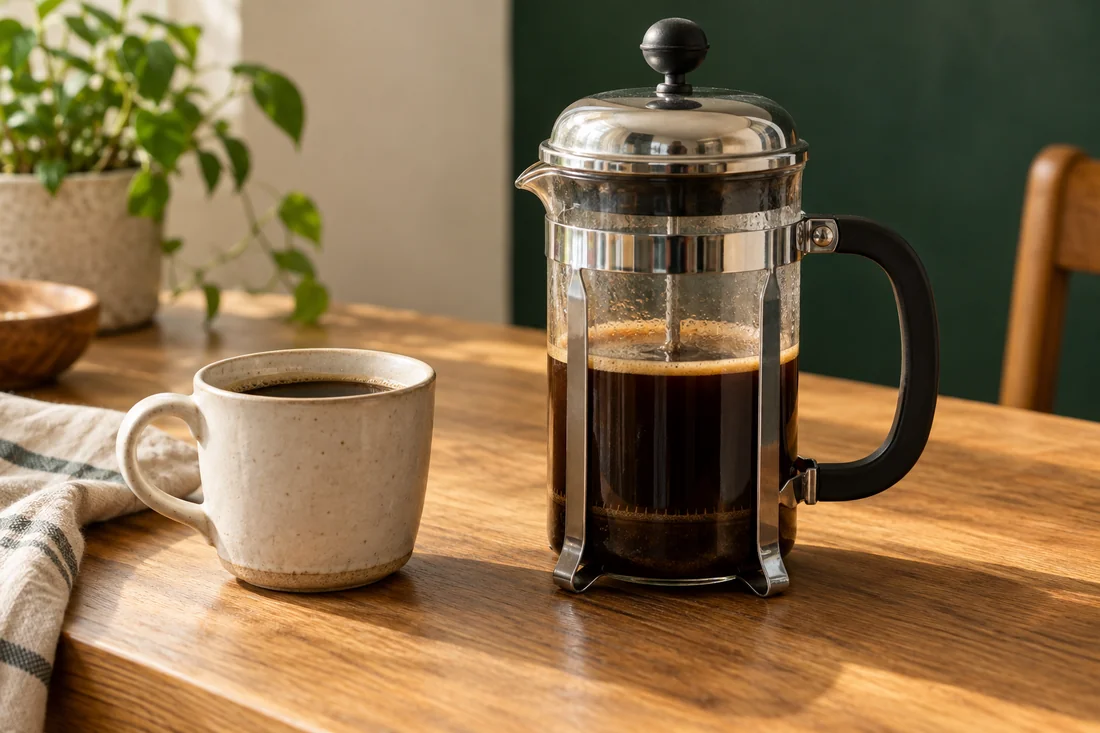
Schematic movement and illustrative AI images. Animations shorten the action; follow the quantities, wait times and safety guidance in the text.
If the flavour is not quite rounded yet
One change. A new attempt.
Lots of grounds in the cup
Do not stir hastily before serving; pour evenly and leave the last sip behind.
Rough or dry
Compare steeping time, grind and roast individually.
Why it works
The details behind the recipe.
Why French Press tastes different
In a French press, coffee and water steep together in the same vessel. This brewing method is called immersion. When you pour, a metal mesh retains the coarser grounds but lets more fine particles and oils through than paper. This explains the full, often textured character. Slight cloudiness is usual with this method and is not a fault in itself.
Quantities and preparation
First check your pot's actual usable capacity. The cup count on the packaging often refers to small servings. Leave room below the rim and do not exceed any fill mark. For your own first trial, you can combine 30 grams of coarsely ground coffee with 450 grams of hot water. The 1:15 ratio draws on Hario's published recipe guidance; it is not a prescribed strength.
You also need a timer and a spoon suitable for your pot’s material. Check the glass for damage. The plunger should sit straight and move without jamming at an angle. A misshapen or damaged filter is not a good foundation for a clean cup.
Step by step
Preheat an undamaged pot with warm water and empty it again. Add the freshly ground coffee.
Carefully pour in the brewing water. Stir briefly and gently so that all the grounds are wet.
Put the lid on without pressing straight away. Start with around four minutes of steeping time as your own comparison point.
Press the plunger down slowly and vertically. Stop if you encounter unusual resistance; never force it.
Carefully pour the coffee into cups or a separate jug. Leave a little sediment in the brewing vessel.
Steeping time is a matter of taste
Four minutes is a starting point. Hario’s published recipe, for example, uses six minutes. Instead of making one number a law, compare two brews with the same dose and different steeping times. Let both reach a similar drinking temperature. Very hot coffee is harder to assess in detail.
If a longer steep gives you more sweetness and balance, keep it. If the cup becomes harsh, check grind and roast as well as time. A dark roast does not automatically become more chocolatey through longer steeping. And extremely coarse grounds are no guarantee of better coffee.
Less sediment in the cup
Frantic stirring just before pouring stirs settled particles up again. Pour steadily instead and leave the last mouthful in the pot. If the mouthfeel fundamentally bothers you, a paper filter is probably a better fit. A French press does not have to become a clear pour-over to be right.
Take apart cleanly
Coffee residues tend to collect between the filter layers. Dismantle the unit according to the manufacturer’s instructions, clean it and let everything dry. If the glass breaks or the plunger jams, do not improvise by reaching into the hot vessel. A clean, freely moving filter is this method’s most important small maintenance task.
Frequently asked
Another question?
Is some sediment normal?
Yes, metal filters do not retain every fine particle. Gentle pouring reduces them.
Can I keep coffee warm in the French Press?
A separate insulated flask is more practical and separates the drink from the grounds.