The guide · Iced Filter

Hot brew over ice

Ice counts towards the water quantity: brew concentrated and chill immediately.

Recipe, techniques and troubleshooting. All on one page.

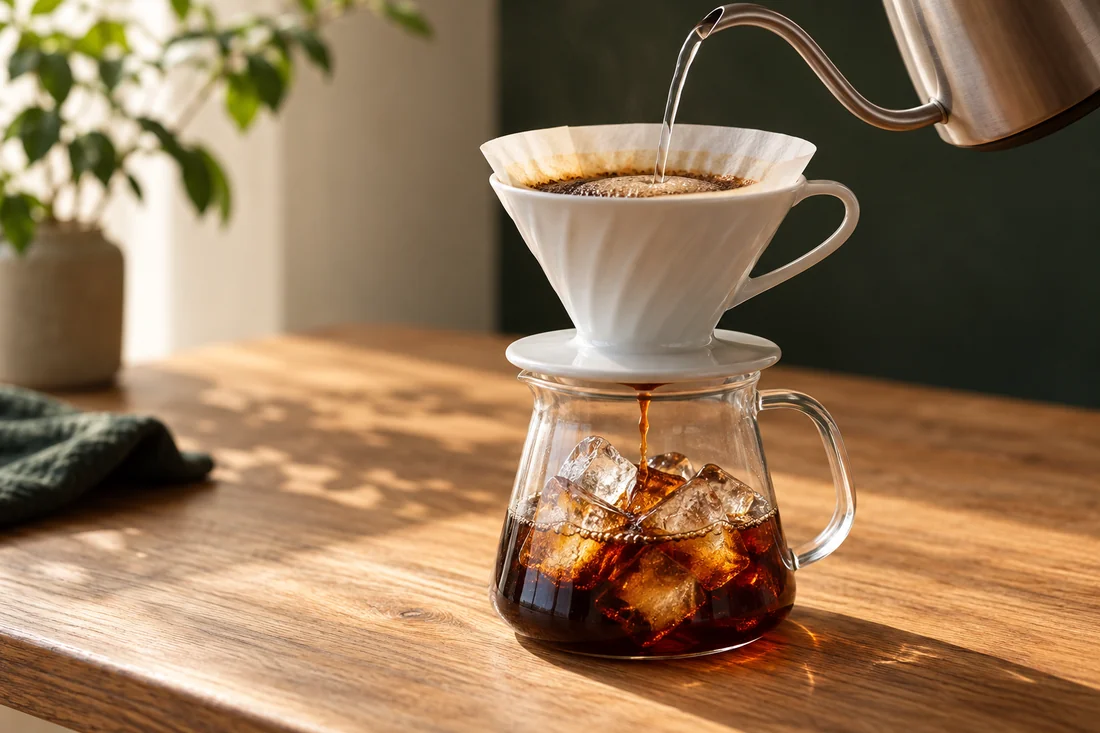
Iced Filter — illustrative image

Your starting recipe

Your cup starts here.

A starting point for your beans and your taste.

Coffee
20 g
Hot water
200 g
Ice
100 g
Total water
300 g including ice

What you need

Have these ready.

Tick off what is ready. You can start at any time.

Now it is time to make coffee

How it works.
Step by step.

Get an overview first. Then work through each action at your own pace.

Coffee
20 g
Hot water
200 g
Stopwatch00:00

The stopwatch starts only when you tap Start. It continues counting across page changes if your browser allows storage. No alarm.

Understand the technique

Does rinse water reach the ice?

Hot over ice: Rinse the filter separately – illustrated techniqueInsert the paper filter and pre-rinse it separately. Remove the rinse water completely.ARinse water out

A · What to observeRinse water is discarded separately and does not enter the drink.

Set out the carafe
100 %

You start the motion. A shortened illustration, not a brewing timer.

01

Step 1 of 5

Rinse the filter separately

Insert the paper filter and pre-rinse it separately. Remove the rinse water completely.

Help with this step

Discard all the rinsing water.

Understand the technique

Is ice part of the water total?

Hot over ice: Weigh the ice and coffee – illustrated techniqueWeigh 100 grams of ice into a suitable jug. Put the dripper on top, add 20 grams of coffee and tare again.AIce is included

A · What to observeWeighed ice is in the suitable carafe; tare again afterwards.

Tare the scale again
100 %

You start the motion. A shortened illustration, not a brewing timer.

02

Step 2 of 5

Weigh the ice and coffee

Weigh 100 grams of ice into a suitable jug. Put the dripper on top, add 20 grams of coffee and tare again.

Help with this step

Do not use a thin drinking glass as a substitute for a suitable jug.

Understand the technique

Is the whole bed wet before the pause?

Hot over ice: Wet with 50 g of water – illustrated techniqueWet the coffee bed with around 50 grams of hot water. Wait roughly half a minute.AFully wet

A · What to observeThe first water portion reaches the dry edges too.

Observe the pause
100 %

You start the motion. A shortened illustration, not a brewing timer.

03

Step 3 of 5

Wet with 50 g of water

Wet the coffee bed with around 50 grams of hot water. Wait roughly half a minute.

Understand the technique

Does the planned brew water pass through the bed?

Hot over ice: Pour to 200 g of hot water – illustrated techniqueContinue pouring slowly until a total of 200 grams of brewing water has passed through the coffee bed.ACalm portions

A · What to observeCalm pouring sends water through coffee, then onto the ice.

Pass through the coffee bed
100 %

You start the motion. A shortened illustration, not a brewing timer.

04

Step 4 of 5

Pour to 200 g of hot water

Continue pouring slowly until a total of 200 grams of brewing water has passed through the coffee bed.

Understand the technique

Is coffee mixed before adding anything?

Hot over ice: Swirl and taste – illustrated techniqueRemove the filter and swirl carefully until as much of the intended ice as possible has melted. Taste before adding more ice or other ingredients.AMix before serving

A · What to observeSwirling combines coffee with the melting ice.

Taste before adding anything
100 %

You start the motion. A shortened illustration, not a brewing timer.

05

Step 5 of 5

Swirl and taste

Remove the filter and swirl carefully until as much of the intended ice as possible has melted. Taste before adding more ice or other ingredients.

Help with this step

Add extra serving ice only after tasting.

Schematic movement and illustrative AI images. Animations shorten the action; follow the quantities, wait times and safety guidance in the text.

If the flavour is not quite rounded yet

One change.
A new attempt.

Weak

Check whether extra ice or rinse water has entered the planned water quantity.

Sharp and unbalanced

With the same ice and water weights, carefully try a slightly finer grind next time.

Why it works

The details behind the recipe.

The key difference

When brewing hot coffee onto ice, the ice counts towards the planned water total. Some water passes hot through the coffee bed; the rest sits frozen in the carafe and melts as the coffee cools. If you pour an unchanged hot filter recipe onto extra ice instead, you dilute it beyond the original ratio.

A recipe idea of your own

As a comparison starting point, use 20 grams of coffee, 200 grams of hot brewing water and 100 grams of ice in the server. That gives you a planned total of 300 grams of water, including the ice. The finished coffee will still weigh less because water stays in the grounds. Adapt this starting recipe to your bean and filter.

Use a vessel suitable for temperature changes. An ordinary thin drinking glass is not a safe substitute for a brewing jug. Ice made from clean drinking water and an odour-free freezer are part of the flavour: frozen kitchen aromas are not something you want to brew along with it.

Step by step
  1. Insert the paper filter and pre-rinse it separately. Remove the rinse water completely.
  2. Weigh 100 grams of ice into a suitable jug. Put the dripper on top, add 20 grams of coffee and tare again.
  3. Wet the coffee bed with around 50 grams of hot water. Wait roughly half a minute.
  4. Continue pouring slowly until a total of 200 grams of brewing water has passed through the coffee bed.
  5. Remove the filter and swirl carefully until as much of the intended ice as possible has melted. Taste before adding more ice or other ingredients.
Why you need to check the grind

Less hot water passes through the coffee bed than in a hot filter coffee of the same size. A grind size that worked there is not automatically right here. If the result is sharp and unbalanced, carefully try grinding a little finer without bringing the filter to a standstill. Keep the other variables the same.

The ratio of ice to hot water is a compromise between cooling and brewing conditions. If a lot of ice remains, the actual dilution is not yet complete at the first sip. If everything melts and the coffee is barely cool, check the starting temperature, vessel and quantities. Adjust the recipe in small steps.

Compare clearly

For a comparison, do not brew once with tiny ice pieces and once with a huge block. Melting speed can differ considerably. Weigh the ice and use pieces that are as similar as possible. Note whether you add extra serving ice after brewing.

A good tasting sample needs neither milk nor syrup. If you like the base, you can make your own drink from it. Citrus peel changes the aroma, milk the mouthfeel, sweetness the perception. These are deliberate recipe changes, not an obligation to repair bad coffee.

For now, rather than storing

This method is particularly suitable when you want a cold coffee now. Serve promptly. For a larger group, brew suitable smaller batches and mix them rather than filling a small dripper to the rim.

Frequently asked

Another question?

Does ice count towards the water quantity?

Yes. Otherwise you dilute your recipe further and without control.

Is that Cold Brew?

No. Extraction begins here with hot water.

Sources & further reading

Related to this topic

Two routes to cold coffee

Prepare the same bean as cold brew and taste it alongside your brew over ice. Note the clearest difference in aroma or mouthfeel.

Cold Brew kennenlernen ↗

Your coffee helper

Coffee Bro.

I help you brew, find coffee knowledge and show you what is on the menu. Your questions stay here in your browser.

Local content & guided help · no connected language model