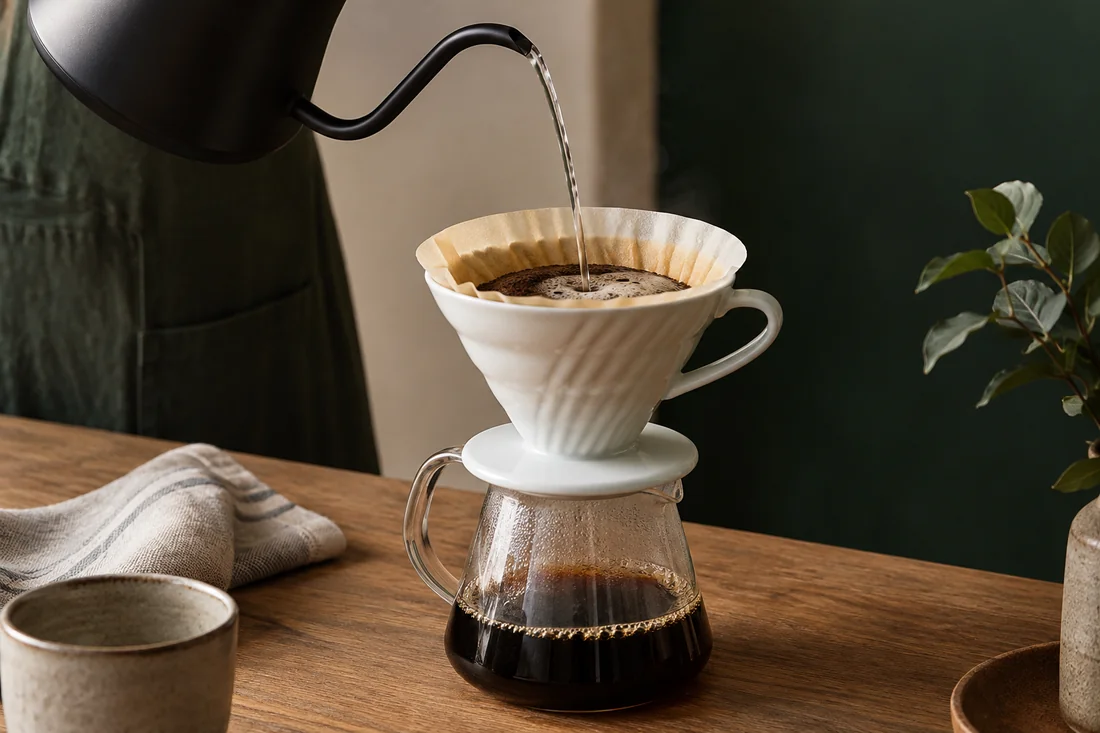
Schematic movement and illustrative AI images. Animations shorten the action; follow the quantities, wait times and safety guidance in the text.
If the flavour is not quite rounded yet
One change. A new attempt.
Small cup brews quickly but tastes rounded
Do not force anything; record the successful process.
Slow and dry
Check whether the grind became too fine solely because of a long recipe time.
Why it works
The details behind the recipe.
Half the amount does not always mean the same process
Less coffee creates a shallower bed in a pour-over filter. This can change water flow and brewing time. Quartering a recipe for four people preserves the mathematical ratio, but not every brewing condition. Treat a single cup as its own recipe. The goal is a good small brew, not the brewing time of a large carafe.
Choose suitable equipment
A small pour-over dripper, a suitable AeroPress or an immersion dripper can be handy for one portion. A large filter machine may have a minimum quantity. Check the manufacturer's guidance before trying to perfect a tiny serving in a large basket. Switching to a suitable brewer may take less effort.
A common manufacturer's starting point for pour-over is 15 grams of coffee and 250 grams of water. If you want only 150 grams of water, 9 grams of coffee gives the same calculated ratio. However, this does not mean the same pouring sequence and grinder setting will work identically.
An organised trial
Decide your desired portion size and check whether the brewer is suitable for it.
Calculate coffee and water in your desired ratio. Weigh small quantities especially carefully.
Reduce the number of pours if lots of tiny portions make the process unnecessarily unsettled.
Log the flow and flavour. Compare the result after brief cooling.
On your second attempt, adjust only the grind or pouring technique, not both at once.
The typical mistake
A small cup drains quickly. That does not automatically mean poor extraction. If it tastes rounded and sufficiently intense, a short recipe is fine. A change is worthwhile only when taste and process together suggest a problem.
Conversely, very fine grounds in a small quantity can produce a sluggish, dry cup. More water is not necessarily the answer. Check whether you have been trying to force the same brewing time as a large pot artificially.
Keep heat loss in mind
With small quantities, a cold brewing vessel has a greater impact. Preheat it appropriately for its material and avoid long pauses between kettle and pouring. A heavy, cold cup can quickly cool a small coffee. That calls for a prepared routine, not risky temperatures.
An alternative without pouring acrobatics
With an immersion dripper, you can steep a small portion with the valve closed first, then release it. Contact time then depends less directly on your pouring speed. The fill limit still matters here. Use the specific model's recipe as guidance and adjust the amount deliberately.
Record the single-cup recipe
Write down not only gram amounts but also filter size, water and number of pours. Then you can repeat the same cup in the morning without having to reconstruct yesterday's hand movements. If you later brew for guests, treat the larger recipe as its own experiment rather than an automatic multiplication.
Frequently asked
Another question?
Should a small cup take as long to brew as a large pot?
No. Bed depth and water quantity differ; taste decides.
What matters most with small portions?
The right equipment size, precise dosing and a preheated setup.