
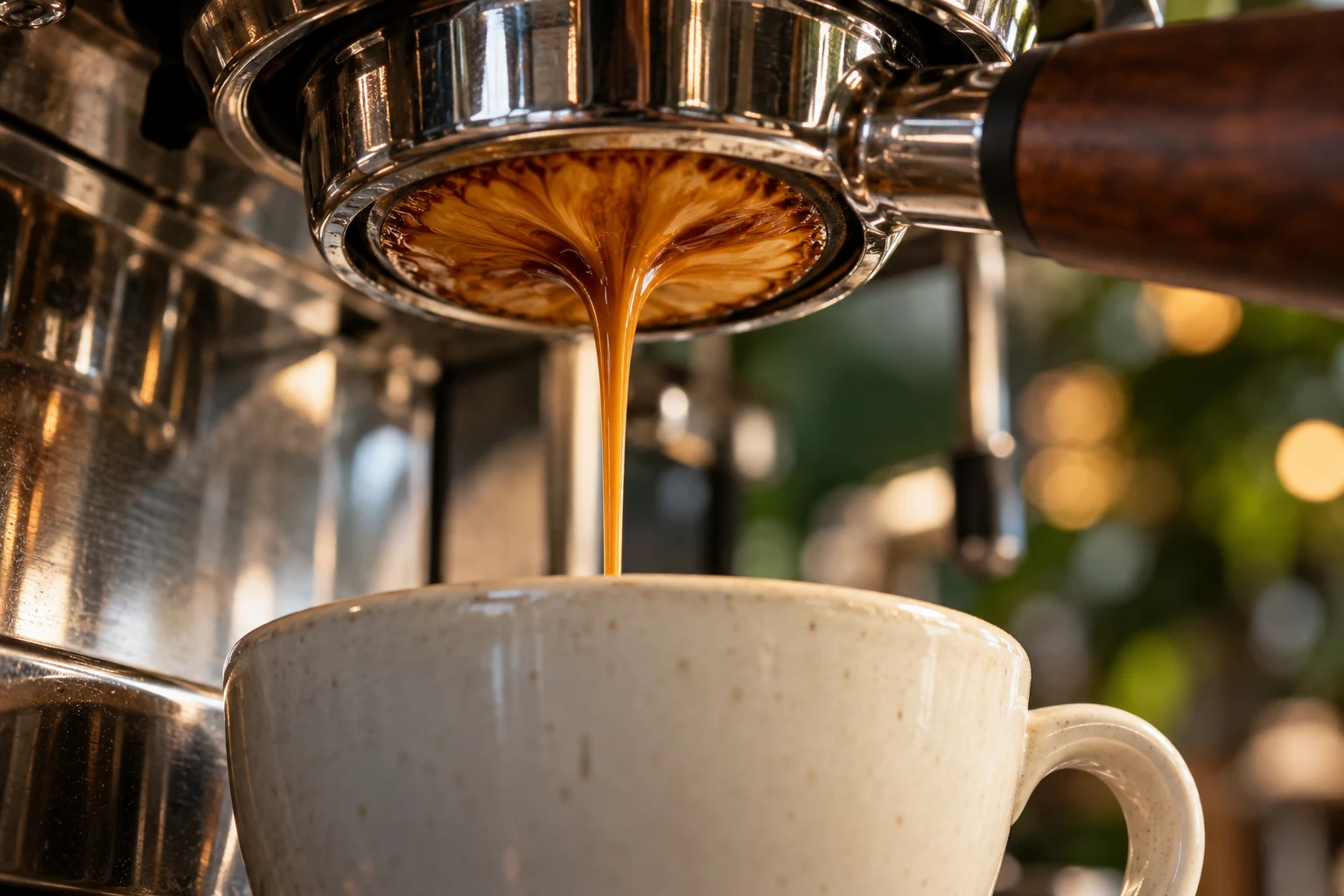
What channeling means
Channeling means that water takes preferred paths through a coffee bed instead of flowing through it evenly. Differences in distribution, density or structure can encourage these paths. Some areas then receive more water, others less. The cup may taste unbalanced as a result. Visible irregularities provide clues; they do not prove the exact flow inside.
You cannot always tell clearly from outside. Spraying from a bottomless portafilter or noticeable fluctuations are clues, but not a full diagnosis. Holes in the spent puck do not automatically tell the whole story of the extraction either.
Typical observations
An extraction begins sluggishly, then suddenly speeds up sharply. Two supposedly identical shots take very different times. The flavour seems both sharp and dry. Such observations justify a look at evenness. They do not prove, however, that a single preparation step alone is responsible.
The order of checks
- Check for a clean, dry basket and a suitable dose.
- Distribute the grounds evenly before tamping. Pay particular attention to visible gaps around the edge.
- Tamp level and handle the prepared portafilter without hard knocks.
- Repeat the same extraction with the same target yield and observe the variation.
- Only then check whether a small grind adjustment improves the situation.
Why grinding ever finer is not a universal solution
Finer grounds often increase resistance. But if water is already taking uneven paths, more resistance can complicate things. A slightly coarser but more even extraction may make more sense than an extreme grind setting with highly variable flow. Decide based on several carefully prepared attempts.
What pre-infusion can contribute
Some machines offer pre-wetting at reduced pressure or a brief, interrupted pulse of water. La Marzocco explicitly distinguishes these functions. They can change how water is introduced but do not replace careful puck preparation. The right setting is machine-specific; do not blindly copy other people’s pressure profiles.
A small test series
Brew three shots with the same bean, dose and drink yield. Focus exclusively on repeatable distribution and a level tamp. Record the times and flavour. If the results are much closer together, the routine has proved a useful lever. You do not need to buy accessories straight away for this.
Keep your eye on the cup
A visually attractive extraction may disappoint in flavour. A flow that is not perfectly symmetrical can still taste good. Use visual clues to form a question, rather than judging the drink before tasting it.
When technical help makes sense
If unusual leaks, error messages or major pressure problems occur despite a careful routine, consult the appliance manual or servicing. Do not open pressurised or electrical components to optimise flavour.