
Why climate matters for coffee
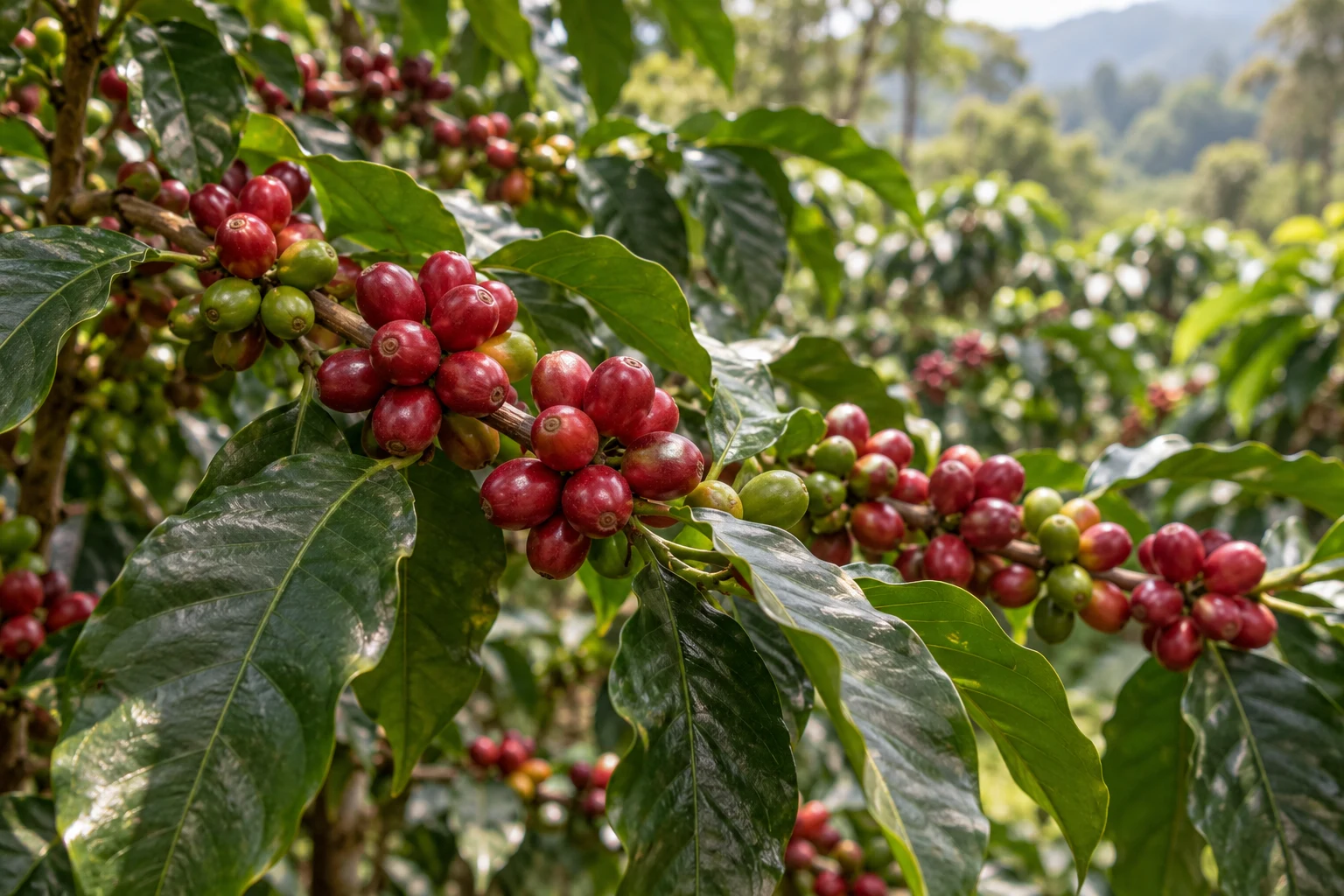
Coffee plants do not grow independently of their surroundings. Temperature, water availability and other growing conditions interact with genetics and cultivation. Changes can therefore affect yields, plant health and a location's suitability. This goes beyond whether a summer felt particularly warm to us.
Among other things, World Coffee Research works on suitable varieties and adaptation to changing conditions. Its variety catalogue stresses that a plant's actual performance depends on its environment. A resilient variety is therefore not a universal solution for every farm.
Adaptation is not a single button
Depending on their situation, farms can work on plant material, soil care, water management and growing systems. Which measures make sense depends on the location and available knowledge. An approach that sounds good in general may have different advantages and drawbacks elsewhere. Sweeping remote diagnoses do little to help people on the ground.
New plants also take time to become commercially productive. Decisions about renewal therefore involve cost and risk. Calling for adaptation is not enough without considering funding and access to suitable material.
Research and diversity
Genetic diversity opens up opportunities to combine different characteristics. Disease resistance, yield and cup potential must be considered together. Focusing only on one currently popular name can needlessly narrow the discussion. Agriculture needs robust solutions for real conditions, not just attractive labels.
Trials in several locations help explain how plants respond to different conditions. Results remain site-specific and need careful interpretation. A single success story does not prove that the same variety brings the same benefit everywhere.
Be careful with big future figures
Projections depend on scenarios, models and assumed adaptations. If you read that a particular share of growing land will become unsuitable by a certain year, ask which study underlies it. Such figures can highlight important risks, but are not an exact prediction for every farm.
Likewise, a possible relocation of cultivation does not automatically mean an easy solution. New growing areas can raise environmental and social conflicts. Existing livelihoods cannot simply be moved at will. A good explanation keeps these connections visible without resorting to images of doom.
What you can actually do
Look for suppliers who clearly explain their sourcing relationships and the measures they support. Ask about specific projects rather than a blanket climate-friendly claim. Buy quantities you will use and avoid unnecessary waste. These everyday steps cannot solve the cultivation crisis alone, but they are more honest than an unsupported zero-impact promise.
Different species and varieties can be interesting for flavour and adaptation. When trying a new coffee, ask which traits matter at that location. Disease resistance, yield and cup profile do not necessarily produce the same ranking. A useful assessment therefore considers the work of people on the ground, environmental conditions and economic viability together.