
Espresso practice · 3 MIN READ

Checking sour espresso

Before grinding finer, establish what bothers you and how your extraction actually runs.

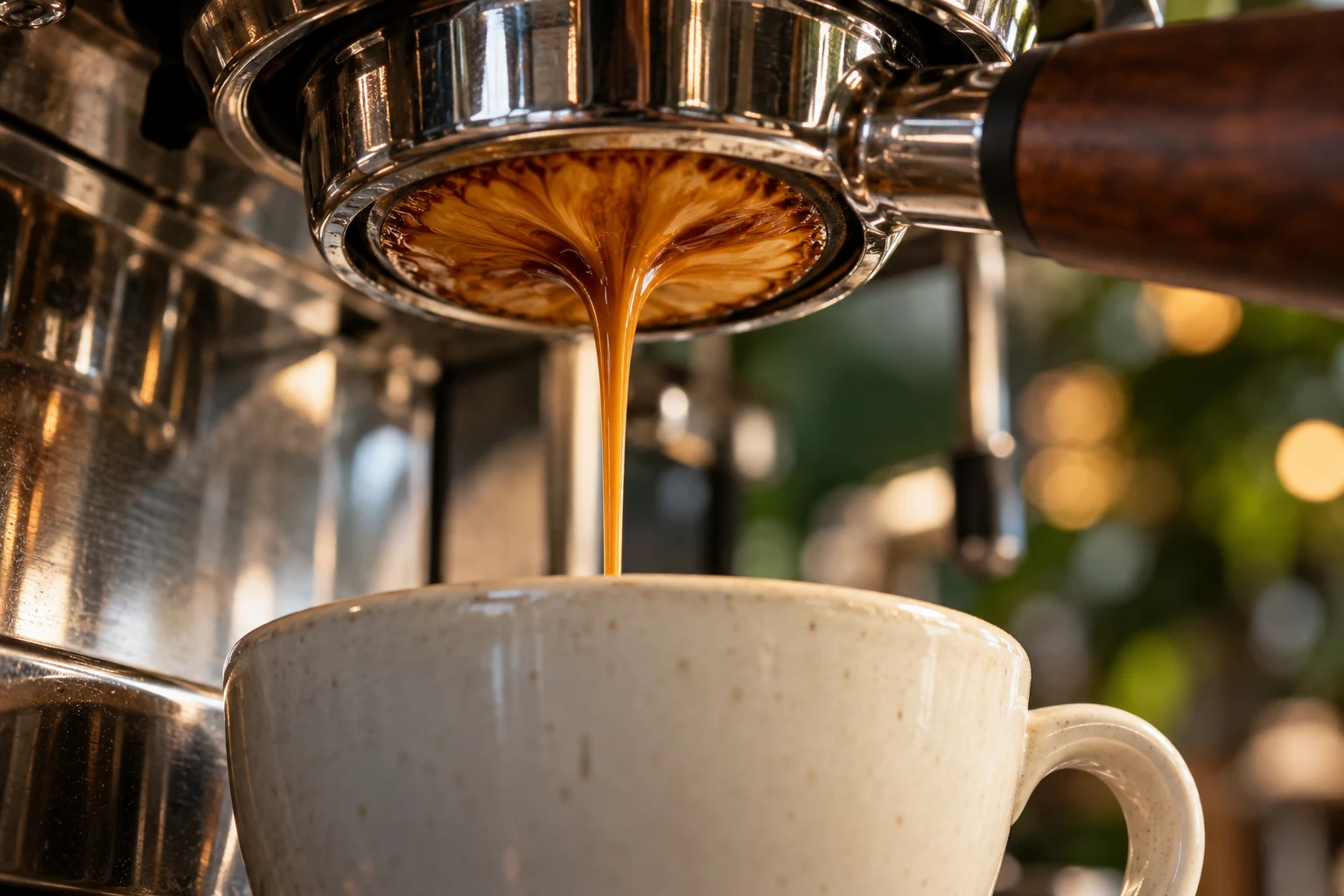
Espresso flowing from a portafilter into a cup

Knowledge you can explore

Sharp or simply fruity?

Three views make the relationship visible. Choose a question, compare the diagram and check your understanding.

Put acidity in contextDistinguish juicy fruit from a sharp impression followed by an empty finish. Check the style promised by the beans and whether the machine and portafilter are ready. Stir the espresso and let it cool slightly. Tasting only crema cannot reliably assess the whole drink in your cup.01 / 03
  1. Juicy fruitJuicy fruit
  2. Sharp and hollowSharp and hollow
  3. Stir and taste warmStir and taste warm

Scroll the diagram sideways to read every label.

Fruity is not automatically faulty

Schematic illustration · not a measurement or real-time demonstration

01 / 03

Put acidity in context

Distinguish juicy fruit from a sharp impression followed by an empty finish. Check the style promised by the beans and whether the machine and portafilter are ready. Stir the espresso and let it cool slightly. Tasting only crema cannot reliably assess the whole drink in your cup.

02 / 03

Flow shapes your next question

Record dose, beverage mass and time from a consistent starting point. If espresso runs unusually fast and seems thin, try slightly finer at the same target output. With even flow, a larger beverage mass is another possible test. Change these variables separately so you can understand the difference afterwards.

03 / 03

Not every coffee needs repairing

Repeat a promising version before adopting it. If a well-prepared coffee still does not suit your taste, less fruity beans may make sense. After changing location, a suitable water comparison can also help. Continue using only water that meets the requirements of your particular machine.

A quick thought check

The espresso is fast, thin and sharp. Which single test fits?

01

Describe acidity more precisely

Before correcting a sour espresso, describe its acidity more precisely. Fruity and juicy is different from sharp, brief and then empty. Acidity can be part of a bean’s intended character. Taste, recipe and brewing behaviour together help you decide whether to work on preparation or choose a different coffee style.

02

Collect the starting data

Record dose, drink yield, time and pre-infusion. Check that the machine and portafilter are ready for use. A first extraction from a system that is not yet sufficiently prepared is no fair comparison with later shots.

Stir the espresso and taste it after it has cooled a little. Tasting only the crema or taking a very hot sip tells you little about the whole drink.

03

A sensible order

  1. Check the bean description and cleanliness. Are you expecting a style this roast is actually aiming for?
  2. Check for a suitable dose and even preparation.
  3. If the shot flows unusually fast and seems thin, try one small step finer with the same beverage yield.
  4. If the flow is even, alternatively test a slightly larger beverage quantity with the grind unchanged.
  5. Compare only one change at a time and record the better version.
04

Why a longer extraction can help

A larger drink yield means more water flows through the puck. That can change the balance and reduce intensity. It is an experiment, not a guarantee. If extraction is already uneven, running it longer may not solve the problem.

05

Do not forget water

Water's buffering capacity affects perceived acidity. If the same bean suddenly tastes much sharper in another setting, comparing water can help. Use only water that suits the machine. An arbitrary switch to distilled water is not a general solution.

06

When you actually want a different style

Sometimes the recipe works yet the coffee still does not suit your preferences. If you want less fruit and more classic roast or cocoa notes, a different bean may make more sense than ever more extreme settings. Taste is not a test of courage.

07

An example for your notes

A useful note might read: “18 grams in, 36 grams out; fast flow; sharp and thin.” For the next trial, keep 18 to 36 unchanged and only make the grind slightly finer. If you also extend the drink to 45 grams, you cannot clearly attribute the difference to one change afterwards.

08

If no change helps consistently

First repeat the same clean procedure. Fluctuating results suggest a different problem from a consistently unsuitable setting. Then check distribution, dose variation and appliance function. A servicing problem should not be hidden by constant readjustment.

Frequently asked

Another question?

Is every sour espresso under-extracted?

No. Bean, water, strength and evenness influence perception.

Should I raise the temperature straight away?

Not as a first reflex. Check quantities, flow and preparation first.

Sources & further reading

Related to this topic

Distinguish fruitiness from imbalance

Describe the acidity first. A specific taste note helps distinguish bean style from a brewing adjustment.

Säure und Bitterkeit unterscheiden ↗

Your coffee helper

Coffee Bro.

I help you brew, find coffee knowledge and show you what is on the menu. Your questions stay here in your browser.

Local content & guided help · no connected language model