
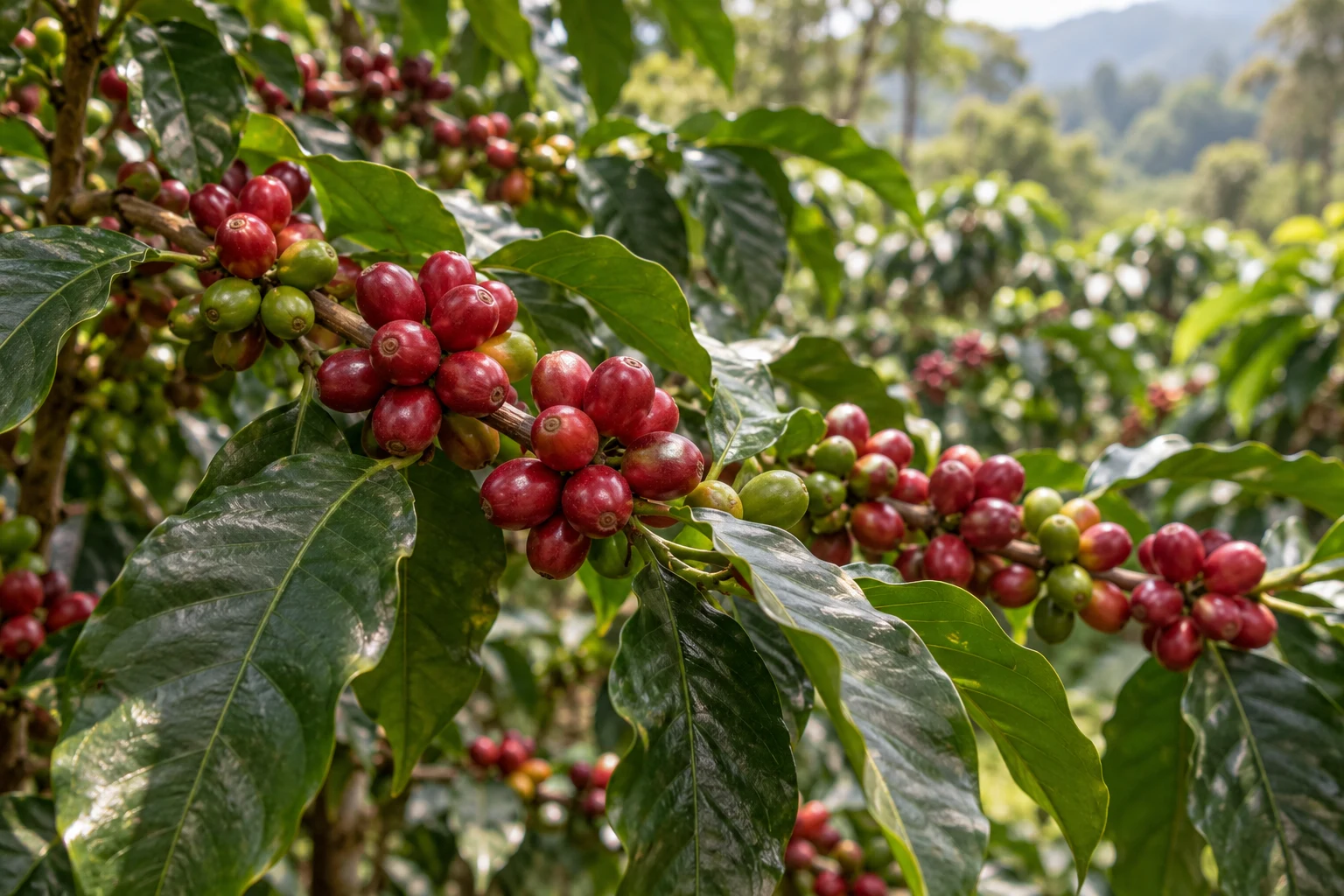
The bean is a seed
What lands in your grinder is the roasted seed of a coffee fruit. The main commercially used species are Coffea arabica and Coffea canephora; you will often see the latter called Robusta. This classification is useful, but does not replace information about growing, harvesting, processing and roasting.
According to World Coffee Research, Arabica is native to Ethiopia. Canephora originates in sub-Saharan Central and West Africa. Today both are grown far beyond these original areas. A country of origin on the pack therefore describes where that coffee was grown, not necessarily the botanical origin of the species.
Distinguishing species, variety and origin
Species is the botanical level, such as Coffea arabica. In the coffee trade, variety usually means a named form or cultivar within a species, such as Bourbon; the term is not always used in a strictly botanical sense. Origin, by contrast, names a geographical connection. Species, variety and origin answer different questions and can all appear on the same bag.
If a pack lists Arabica, Colombia and a variety, that is not a contradiction. It describes different levels of the same bean. A regional description alone also leaves open whether coffee came from one farm, a cooperative or several farms combined.
Why a simple ranking is not enough
The claim that Arabica is good and Robusta is bad is too simplistic. Both categories include very different qualities and uses. The species name alone cannot replace careful processing. Likewise, a high Arabica content does not automatically make poorly stored or unsuitably roasted coffee pleasant.
When choosing, it helps more to ask about the specific flavour profile and intended brewing method. Would you like a compact espresso blend for milk drinks or a transparent filter coffee? Your goal helps determine which qualities you value. A product may suit one purpose and be less suitable for another.
What plants need on the farm
Yield, health and cup potential depend on more than genetics. Location, weather, soil nutrition and care all interact. The WCR variety catalogue therefore describes characteristics and suitable conditions rather than one best coffee plant. Disease resistance or reliable yield can be just as crucial to a farm as a top sensory score.
For us as coffee drinkers, this means that not every interesting word on a pack guarantees quality. A rare variety can be exciting, but price, availability and flavour depend on many other decisions. Curiosity is more useful than automatically awarding extra points for an exotic-sounding name.
How to read your next pack
First look for species, origin and, where applicable, variety. Add processing method, roast description and preparation recommendation. If information is missing, you can ask. Its absence alone does not prove poor coffee, but limits how precisely you can assess it.
Try two different coffees prepared similarly and record your impression before comparing the descriptions. This helps you discover your preferences without declaring an entire plant species the winner before your first sip.