
Basics · 3 MIN READ

Grind setting

A small turn changes contact area and water flow. The number on your grinder applies only to your appliance.

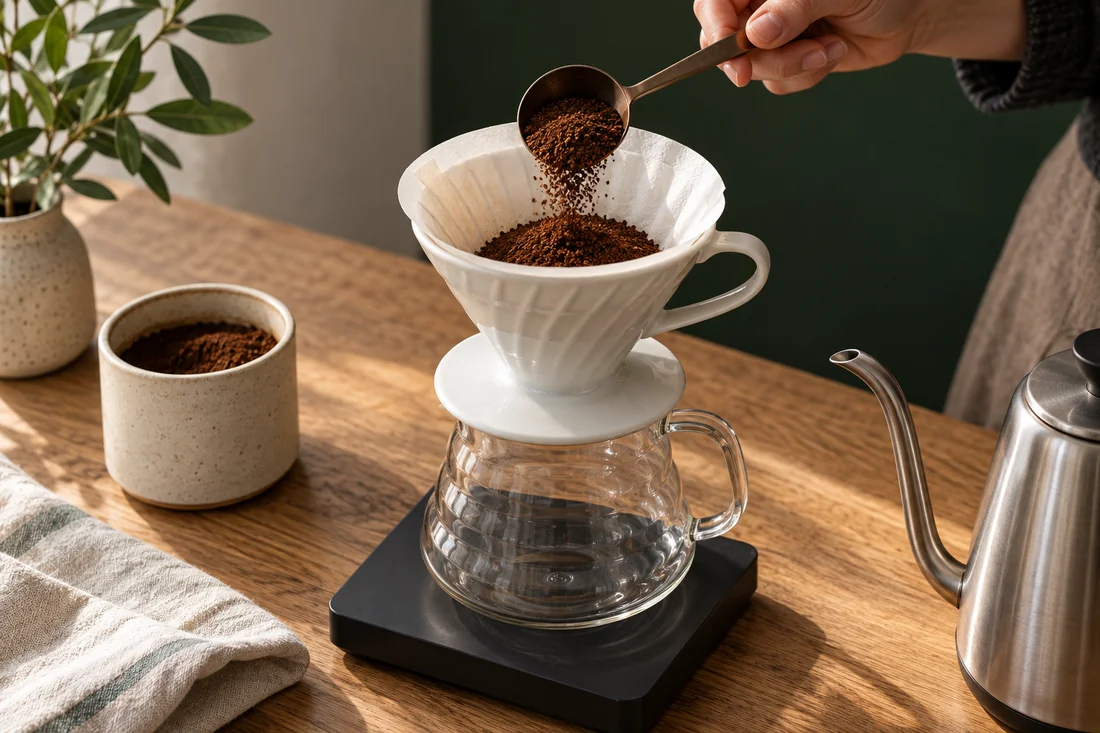
Ground coffee being added to a paper filter

Knowledge you can explore

One turn, two effects

Three views make the relationship visible. Choose a question, compare the diagram and check your understanding.

Smaller pieces, more surfaceGrinding creates particles of different sizes. A finer setting means smaller pieces on average and more accessible surface. It also changes resistance within the coffee bed. Your grinder therefore affects both the release of soluble material and the route water takes through the coffee.01 / 03
  1. Coarse particlesCoarse particles
  2. Fine particlesFine particles
  3. More surface areaMore surface area

Scroll the diagram sideways to read every label.

Finer also changes flow

Schematic illustration · not a measurement or real-time demonstration

01 / 03

Smaller pieces, more surface

Grinding creates particles of different sizes. A finer setting means smaller pieces on average and more accessible surface. It also changes resistance within the coffee bed. Your grinder therefore affects both the release of soluble material and the route water takes through the coffee.

02 / 03

Your grinder has its own scale

Espresso usually needs much finer grounds than a French press. The right setting also depends on the coffee, dose and equipment. A number from somebody else’s recipe is therefore no shared unit of measurement. Record your own grinder setting alongside the result in your cup.

03 / 03

Make one small adjustment

Keep coffee, water and preparation unchanged while testing two neighbouring settings. Compare taste and time at similar drinking temperatures. Allow for grounds retained from the previous setting. If identical attempts vary widely, check the consistency of your preparation before making more adjustments to the grinder.

A quick thought check

Two supposedly identical shots vary widely. What should you check first?

Explore the numbers and controls

02 / The small adjustment

Medium

Schematic particles · not a grinder scale

Explore grind size

Small pieces.
Big difference.

Finer grounds offer more accessible surface area. They also change the resistance to water in the coffee bed.

Medium: your pour-over starting point.

Start with a medium grind. Compare a small change at the next brew, keeping coffee and water quantities the same.

These are broad guides. Bean, dose, filter and grinder all contribute. Fine is not automatically better; a number cannot be transferred between grinders.

Understand grind more precisely ↗
01

What happens during grinding

Grinding breaks the bean into particles of different sizes. A finer setting makes them smaller on average and increases their accessible surface area. It also changes the resistance a coffee bed offers to water. Grind therefore affects both the extraction of compounds and the flow. How much depends on the method, grinder and recipe.

The grinder does not produce identical cubes. Small fine particles are part of the distribution. Two grinders may look as though they grind similarly yet behave differently in the filter. Terms such as sandy or caster-sugar fine help with broad orientation, but do not replace your own brewing trial.

02

Identify your method first

A portafilter machine normally needs much finer grounds than a French Press. With a moka pot, tamping is explicitly undesirable, and very fine espresso grounds may be unsuitable. A paper pour-over filter typically sits between these extremes. The right setting also depends on dose, bean and device.

Do not copy a number from a recipe without knowing the grinder. Setting eight on machine A may mean something entirely different from setting eight on machine B. Instead, record your own setting together with the result.

03

How to make sensible adjustments

  1. Record coffee quantity, water quantity and process. Brew a starting point and note flavour and time.
  2. Adjust the grinder by only one small step and according to its operating instructions.
  3. Allow for retained grounds. The next portion may still partly come from the old setting.
  4. Brew again, keeping all other quantities unchanged. Compare the cups at similar temperatures.
04

When finer can help

A very fast, sharp and thin extraction is a reason to try a finer grind. A blocked, harsh and dry drawdown may suggest one step coarser. Both are working hypotheses. Poorly distributed grounds, a dirty basket or unsuitable paper cannot reliably be fixed through the grinder alone.

In immersion methods, the water initially stays with the coffee. Grind size affects timing differently here than in an open filter. A longer steep does not automatically make coarse grounds equivalent to fine grounds; it is a different variable.

05

Compare adjacent settings

Choose two neighbouring settings and note intensity, acidity and aftertaste for each. If the difference is barely noticeable, you do not need to keep turning endlessly. First repeat one setting. Large variations between identical attempts point to an inconsistent process, not immediately to the wrong number.

06

The limits of accessories

A good grind matters, but cannot replace suitable beans or clean water. Even an expensive grinder cannot transform a roast whose flavour you fundamentally dislike. Start with your taste and use technology as a tool.

Frequently asked

Another question?

Can I transfer grind settings between grinders?

Only very approximately. Scales and burr sets differ.

Is finer always stronger?

No. A finer grind also changes flow and evenness.

Sources & further reading

Related to this topic

Check one small adjustment

First note whether the cup is sharp, drying or not intense enough. Then test one small grind adjustment with the same quantities.

Mahlgradversuch festhalten ↗

Your coffee helper

Coffee Bro.

I help you brew, find coffee knowledge and show you what is on the menu. Your questions stay here in your browser.

Local content & guided help · no connected language model