
Why grams are so practical
Spoons and cups are convenient, but the quantities they hold can vary. Scales let you describe exactly how much coffee and water you use. For espresso, also measure the beverage mass. This lets you repeat a successful recipe without crema height or a differently heaped spoon changing the calculation.
You do not automatically need an expensive specialist device. What matters is sufficient resolution, a reliable display, appropriate capacity and a size that fits your setup. A large filter jug has different space requirements from small scales under a portafilter.
Check before grinding finer
Place the scales on a firm, level surface and tare them with your vessel in place. Check whether the reading stays stable with a stationary weight. If it drifts noticeably, check the power supply, surface and manufacturer's guidance. An unreliable measurement cannot be compensated for with an even more precise recipe.
Acaia describes checking the display against a reference weight and the scale’s own adjustment process. Use a suitable calibration weight of the specified size and follow your scale’s instructions. Whether and how often checks are needed depends on the device and its use. An object with a merely assumed weight is not a reliable reference.
What a kettle should do
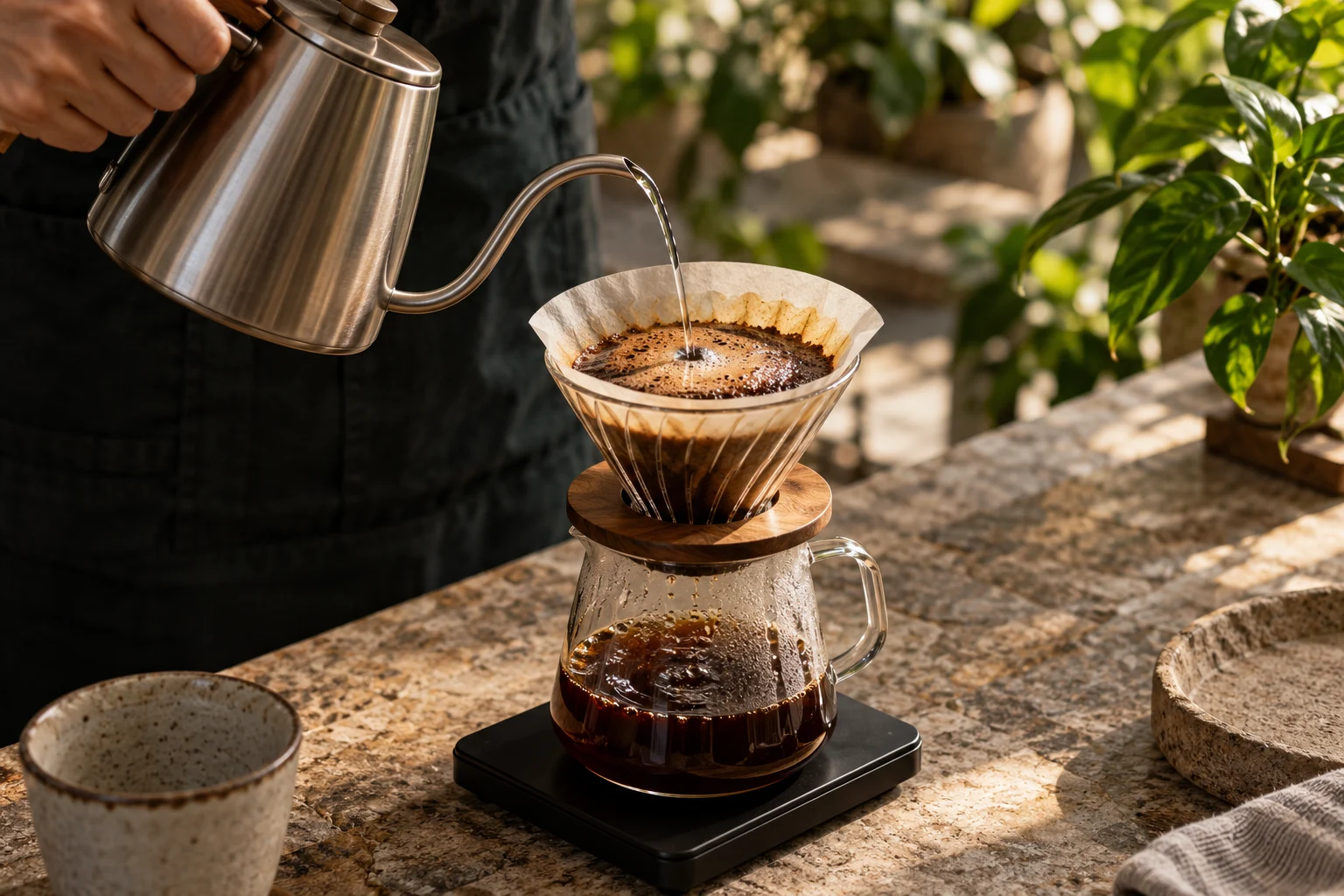
A well-controlled spout is useful for pour-over. You want to distribute water precisely, without sudden gushes. A gooseneck can help, but is not essential for every good cup. With French press or other immersion methods, the shape of the stream is often less important.
Check capacity, how the handle feels and the manufacturer's permitted minimum fill. A very large kettle can be unwieldy for small single servings. A temperature setting is practical for repeated experiments, but does not replace the other recipe variables.
An easy introduction
For example, weigh out 15 grams of coffee and use 250 grams of water as a starting ratio for a suitable filter setup. The particular method also needs its own recipe. Record the quantities instead of topping up by feel. If the cup is too strong, you can deliberately change the ratio on your next attempt.
Watch the water stream and level in the filter as you pour. A steady movement helps more than constantly checking a tenth of a second. Put the kettle down safely and keep cables and hot vessels out of small children's reach.
Accessories only for a specific gap
A phone timer may be enough to begin with. Built-in timing is convenient, but no proof of quality. Likewise, you do not need an app to weigh 250 grams of water. Decide by asking which action currently feels unclear or awkward.
If the quantities are right and the process feels comfortable, give your next attention to tasting. Measuring tools provide a basis for comparisons. No display can decide whether you like the result.